Charles Ponzi
TAP TO READ FULL NARRATIVE — THE NAME (3,800 WORDS)
Every fraud in this series has a name. Hushpuppi. Do Kwon. Madoff. Holmes. Ignatova.
One of them gave a name to the crime itself.
Not the crime he invented — the crime that carries his name was running before he arrived, and was running after he left. What he contributed was not the mechanism. The mechanism is older and simpler than any one person. What he contributed was the version that stuck: the execution, the scale, the public spectacle, and the fall that was so complete and so documented that the newspapers found the words for it, the courts found the law for it, and the English language absorbed his name as the permanent label.
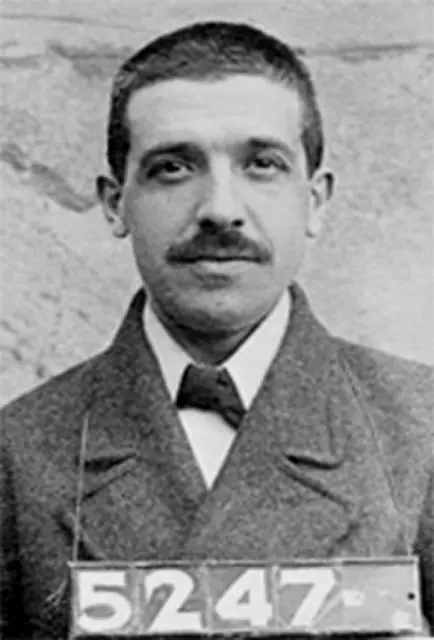
Carlo Pietro Giovanni Guglielmo Tebaldo Ponzi. Born March 3, 1882, in Lugo, a town in the Emilia-Romagna region of what was then the Kingdom of Italy. Died January 18, 1949, in Rio de Janeiro, Brazil, aged 66, in a charity ward.
Between those two facts: three countries, three prisons, one wife, one deportation, a promise of 50% in 45 days, and approximately $20 million in 1920 dollars — roughly $237 million in 2024 purchasing power — taken from somewhere between ten thousand and forty thousand investors who believed him. [SOURCE: case brief citing primary sources; exact victim count is contested in the historical record]
He did not invent the Ponzi scheme. He made it his name.
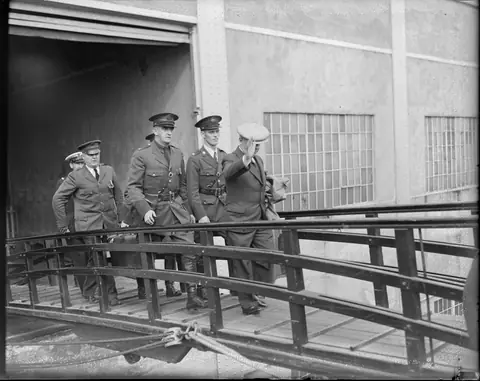
He arrived in Boston on November 15, 1903, aboard the S.S. Vancouver, sailing from Genoa. By his own account, he had $2.50 in his pocket. [SOURCE: Ponzi's autobiography, The Rise of Mr. Ponzi — use with care: self-serving. The $2.50 figure is widely repeated from his own telling.]
The Italian emigrant arriving in America with next to nothing and building something large is a specific narrative that Ponzi understood and deployed. He told the $2.50 story. He told it as an origin — the proof that he had started from the bottom, that the rise was self-made, that the money was the result of extraordinary individual capacity rather than inherited advantage. The story, whether strictly accurate or not, was part of the persona from the beginning.
He was well-educated by Italian provincial standards — he had attended the University of Rome for a time before family financial pressures ended his studies. He arrived in America speaking limited English, with facility in Italian and, eventually, several other languages. He was charming, social, and good at reading rooms. These were the tools he had.
His early years in America were characterised by a series of jobs — waiter, clerk, import-export agent — and a series of failures and marginal dealings that did not yet rise to the level of crime but established a pattern: he was drawn to schemes at the edges of the legitimate, to the gap between what was promised and what was delivered, to the specific opportunity created by the difference between what people believed and what was true.
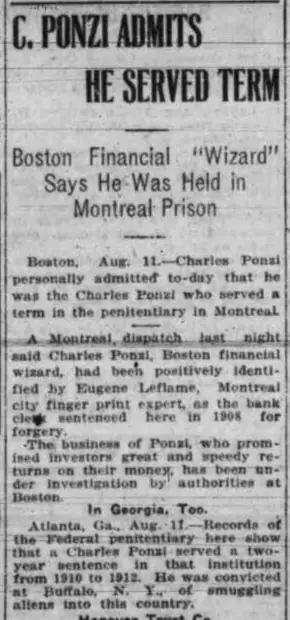
In 1907, he moved to Montreal. There he became involved with a bank — Banco Zarossi — that was itself operating a fraud, paying interest on deposits from later depositors' money. He learned something from this, even if he did not design it. He was convicted of forgery in connection with these activities and served three years in a Canadian prison from 1908 to 1911. [SOURCE: case brief citing primary record]
He returned to the United States. He was later arrested in Atlanta in connection with smuggling Italian immigrants across the border and served time at the federal prison there, where he became a translator for the prison warden — a detail that speaks to both his linguistic ability and his social skill, two of the essential tools he would later use at scale.
In 1918, he married Rose Maria Gnecco, a Boston stenographer. He was 36 years old. He had a criminal record in two countries and, by most measures, no particular prospects. He was also, within two years, going to be the most famous man in Boston.
The mechanism Ponzi used was, in principle, real. International postal reply coupons existed. The price discrepancy he described was real — in some countries, particularly Italy, where the currency had weakened after the First World War, you could buy reply coupons cheaply in local currency and redeem them in the United States at a higher fixed face value. [SOURCE: Investopedia; widely documented from case record]
The arbitrage was legitimate in theory. Buy low in Italy. Redeem high in America. The spread is profit. Ponzi proposed to do this at scale, and to share the returns with investors: 50% profit in 45 days, or 100% profit in 90 days. Investors would give him money, he would run the arbitrage, and they would collect. The promise was almost irresistible.
The problem, identified quickly by investigators at the time and documented by Clarence Barron of the Boston News Bureau, was simple arithmetic. The volume of international postal reply coupons in actual existence across the world was nowhere near sufficient to generate the returns Ponzi was paying. If he had been genuinely doing the arbitrage at the scale his investor inflows required, he would have had to purchase essentially all the reply coupons in existence and then some. The mechanism was real. The mechanism at this scale was impossible. [SOURCE: Barron's investigation, documented in Boston Post exposé, August 2, 1920]
What he was actually doing: paying early investors with later investors' money. The returns were real, in the sense that people actually received them. But the returns were not generated by the arbitrage. They were funded by the deposits of the people who had invested after them. As long as new money was coming in faster than redemptions were going out, the scheme worked. When that balance reversed, it collapsed.
He knew this. The mechanism was the cover story, not the engine.
This must be stated directly because it is both true and important: Charles Ponzi did not invent the Ponzi scheme.
The structure he used — paying earlier investors with later investors' money, maintaining a cover story about legitimate returns, collapsing when inflows can no longer fund redemptions — was not his invention. It predates him. It had been used before him by multiple operators in multiple contexts.
The most directly relevant precedent is William W. Miller, a Brooklyn bookkeeper who in 1899 ran what newspapers called the 'Franklin Syndicate' — promising 520% annual returns and attracting approximately $1 million in deposits before the scheme collapsed. [SOURCE: case brief citing Wikipedia / WeTrust reference; flag: secondary sources — verify against primary before final publication] Miller became known in the press as '520% Miller.' He ran his scheme twenty years before Ponzi ran his.
Ponzi may have been inspired by Miller — the case brief flags this as 'may have been' rather than confirmed, and that is the correct framing. [SOURCE: case brief sourcing note] The connection is plausible given the timing and the press coverage Miller received, but the direct line of influence is not settled in the historical record.
Why does this matter to the series? Because the structure Ponzi made famous is the same structure that runs through every case in this collection. Madoff paid earlier investors with later investors' money. Ignatova sold coins that were numbers in a database funded by the deposits of people who came after the people being paid. Stanford paid CD returns from new investor capital. Holmes raised valuations built on investor money that was funding the lifestyle rather than the research. The mechanism is ancient. What changes is the wrapper.
Ponzi's name is on it not because he invented it but because he did it in one summer in one city with one promise, and the newspapers found it and documented it in a way that made it permanent. The Boston Post won its first Pulitzer Prize partly for this story. [SOURCE: case brief — verify Pulitzer attribution to primary before publication] The crime needed a name. He was there when the name was assigned.
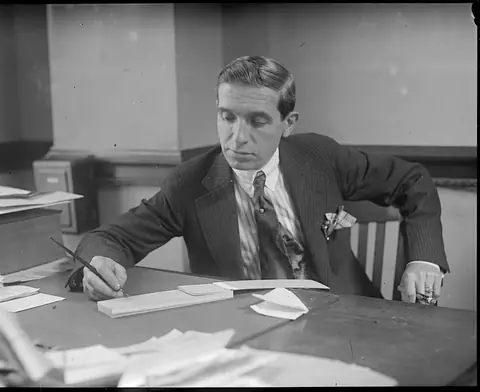
In late 1919, Ponzi founded the Securities Exchange Company in Boston. He began accepting investor money on his promise of 50% returns in 45 days, backed by the international postal reply coupon arbitrage story.
He was good at this. The immigrants who had come to Boston as he had — Italian, Jewish, Irish, working class people who knew what it was to arrive with nothing and build toward something — were exactly the audience for a man who told a story of found opportunity. He did not pitch them as marks. He pitched them as insiders. He was letting them in on something that the wealthy already understood and that ordinary people could now access if they were smart enough to see it.
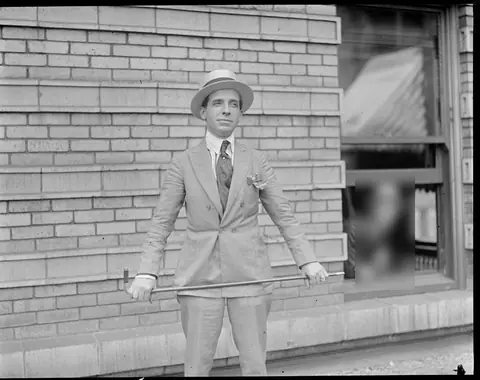
The money came in slowly at first, then faster. He paid his early investors — they received their returns on time, told their friends, and the friends came. By mid-1920 he was one of the most famous men in Boston, celebrated in the press as the financial wizard who had discovered a way to turn paper coupons into extraordinary profits, the immigrant who had cracked the system and was now sharing the discovery with his community.
On July 24, 1920, the Boston Post ran a favourable article about Ponzi. Investors poured in faster than ever. By some accounts he was taking in approximately $250,000 a day at the peak — the equivalent of several million dollars in contemporary terms. [SOURCE: case brief citing historical record; flag: this figure has not been independently verified to primary — treat as illustrative of scale, not as precise]
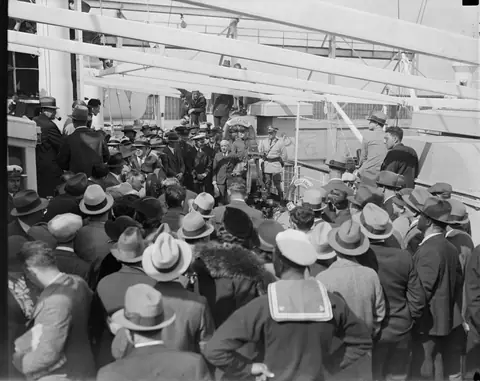
Two days later, on July 26, a bank run hit his office. Investors tried to withdraw simultaneously. He paid them. All of them. He stood in front of the crowd and paid everyone who came, and by the end of the day the bank run had dissolved into cheering. The man had held. The man had paid. The man must be legitimate.
He was not. He had paid the bank run from new investor deposits that had come in during the same days. He was paying old money with new money. The run had tested the scheme and the scheme had survived — but only because new inflows had happened to exceed the redemptions at exactly the right moment.
One week later, the structure was exposed.
On August 2, 1920, the Boston Post turned.
Clarence Barron of the Boston News Bureau had been investigating Ponzi's operation. The investigation was, in part, funded by the Post — which paid Ponzi's former publicity agent, William McMasters, $5,000 for his insider account of what he had seen. [SOURCE: case brief — flag: verify exact McMasters payment figure to primary before publication]
The story the Post published was based on Barron's arithmetic and McMasters's testimony. It was direct. Ponzi claimed approximately $7 million in liquid assets. The actual figure, investigators determined, was a deficit — he was at least $2 million in debt and possibly up to $4.5 million in the red. [SOURCE: case brief citing Boston Post exposé, August 2, 1920; Boston News Bureau]
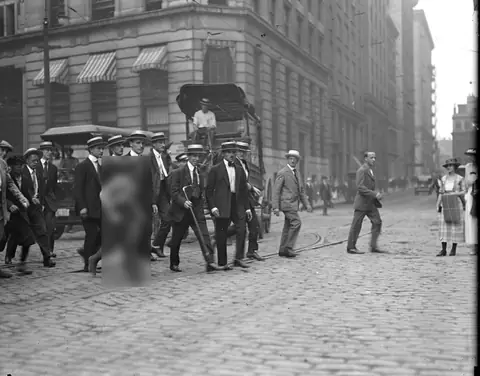
The Massachusetts Attorney General, J. Weston Allen, moved immediately. The Hanover Trust bank, which had been processing Ponzi's transactions, was ordered to stop honoring his checks. State auditors descended. Involuntary bankruptcy was filed by a group of small investors.
On November 12, 1920, the federal bankruptcy court issued its ruling: In re Ponzi, 268 F. 997 (D. Mass.). [SOURCE: primary legal citation] The scheme was documented, the losses tabulated, the legal framework established.
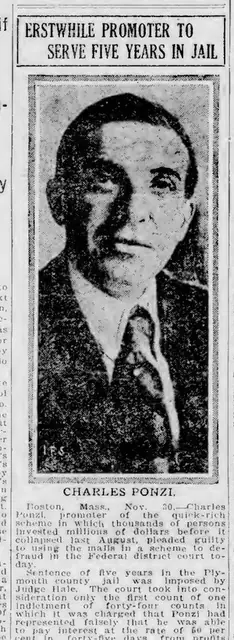
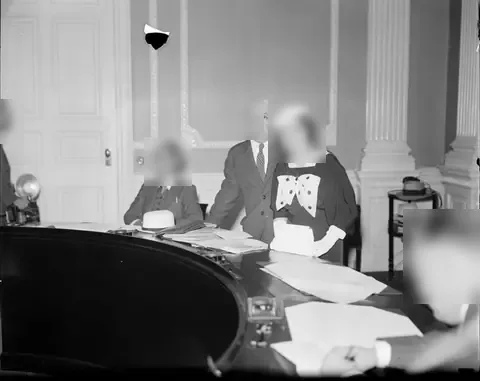
On November 30, 1920, Charles Ponzi pleaded guilty to 22 counts of larceny in Suffolk County, Massachusetts. [SOURCE: ABA Journal; case brief citing Suffolk County record]
The Boston Post's investigation is one of the most consequential pieces of financial journalism in American history. The paper received the Pulitzer Prize. The story it broke gave the English language a new word for a specific category of crime. The story was better documented and more consequential than most financial journalism produced before or since — because the crime it exposed was so clean, so structurally legible, and so scalable that every subsequent fraud of the same kind would eventually be measured against it.
The criminal record of Charles Ponzi is long and runs across three countries.
Canadian prison, 1908–1911: three years for forgery, connected to his involvement with Banco Zarossi in Montreal. [SOURCE: case brief citing primary record]
US federal prison, 1920–1922: sentenced to five years for mail fraud in connection with the Securities Exchange Company scheme; served approximately three and a half years before being released to face state charges. [SOURCE: case brief]
Massachusetts state prison, 1927–1934: nine years for larceny. The state charges had been contested across several years of legal proceedings — during which he ran a land fraud scheme in Florida in 1925, for which he was separately prosecuted. He was, while fighting the Boston conviction on appeal, running another fraud. The Florida scheme collapsed when he was convicted in Massachusetts. [SOURCE: widely documented; Florida land scheme is part of the public record]
He was deported in 1934, after serving the state sentence. He went to Italy — then under Mussolini's government — and worked in various capacities including for the state airline. He eventually moved to Brazil. He taught English. He gave private lessons. He had, by his own later accounts, very little.
On January 18, 1949, Charles Ponzi died in a charity ward at the Hospital Umberto I in Rio de Janeiro. He was 66 years old. He had been partially paralyzed by a stroke. He had, by some accounts, approximately $75 in cash at the time of his death. [SOURCE: widely reported — verify to primary before publication]
His wife Rose had divorced him in 1937 after years of separation. She died in 1963, having rebuilt a life separate from his name.
Much of what people know about Charles Ponzi is repeated, not sourced.
The $2.50 figure comes from his own autobiography, The Rise of Mr. Ponzi, published in 1937. The book is self-serving and romanticising, and the specific details it contains should be treated as Ponzi's version of his own story rather than as verified historical record. He was, among other things, a man who understood the narrative value of an origin story. Whether he truly arrived with $2.50 or whether that number was chosen for its poetic quality is not definitively established.
The $250,000 per day figure — his peak intake — appears in historical accounts and is structurally plausible given the total documented losses and the time frame. It has not been independently verified to a primary financial document in the academic literature available at the time of this writing.
The William W. Miller connection — that Ponzi was inspired by or modelled on '520% Miller' — is plausible but not confirmed. The case brief correctly frames this as 'may have been.' It is included here because it is the most direct documented precedent and because the pattern similarity is exact: the promise, the mechanism-as-cover-story, the collapse. Whether Ponzi knew about Miller specifically or arrived at the same structure independently is a historical question that remains open.
What is not myth: the legal record. The federal bankruptcy ruling is a primary document. The guilty plea is a primary document. The Boston Post investigation was contemporaneous journalism that has been verified by subsequent historians. The charges, the convictions, the sentences — these are in the record.
Where this piece relies on secondary sources or contested figures, those are flagged. The appendix lists verification targets. Handle the myth carefully — the record is better than the legend.
Every case in this series descends from this one structure. Not from Charles Ponzi — from the structure he made famous.
Case 001: Hushpuppi paid for his Instagram lifestyle with money from wire fraud. The lifestyle was the product. The money was a Ponzi, in the broad sense: the later victims funded what the earlier investment in his brand produced.
Case 002: Malone Lam's operation was not a Ponzi in the classic sense — it was straightforward theft. But the spending spree that consumed $230 million in a month was funded in exactly the same way Ponzi's payments to early investors were funded: by taking real money and using it to demonstrate that the thing was working.
Case 003: Do Kwon's algorithmic stablecoin was explicitly a Ponzi-adjacent structure. The yields paid through Anchor Protocol required continuous inflows to sustain. When the inflows stopped, the yields stopped. The mechanism that was supposed to be self-sustaining was funded by new capital.
Case 004: Madoff ran the cleanest Ponzi in this series — 48 years of fabricated statements, paying earlier investors from later investors' deposits. He is, of all the cases here, the direct descendant.
Case 005: Bankman-Fried's FTX used customer deposits — new money — to cover Alameda's losses, which were in part the result of earlier speculative positions. The structure was a Ponzi on the assets of the exchange.
Case 007: Holmes's Theranos raised investor money to fund a lifestyle and a product development process that was not producing what investors were told. New money covered the gap between what existed and what was promised.
Case 008: Ignatova's OneCoin was Ponzi in structure and explicit in mechanism: new investor deposits paid earlier investors' 'returns' from a coin that had no underlying value.
Case 009 Stanford: certificates of deposit paying above-market returns, funded by later investor deposits rather than a legitimate investment portfolio.
Ponzi's scheme ran in Boston in 1920. He made it famous enough to name. Every case in this series is a version of the same thing, run with different wrappers, in different centuries, across different asset classes and geographies. The structure is the same. It survives while inflows exceed redemptions. It collapses when they don't.
He died in a charity ward in Rio de Janeiro on January 18, 1949. He was 66 years old. He was partially paralyzed. He had, by most accounts, next to nothing.
He had arrived in Boston in 1903 with $2.50 in his pocket — by his own telling. He died in Brazil with approximately $75. Between those two numbers: Montreal, Atlanta, Boston, Miami, Italy, Brazil. Three prisons. One wife. One divorce. One deportation. One summer in which he was the most famous man in Boston, and the rest of his life in which he was the man the summer was named after.
He had run his scheme for a little over a year. He had taken in approximately $20 million in 1920 dollars — roughly $237 million in 2024 purchasing power — from somewhere between ten thousand and forty thousand people who believed him. [SOURCE: case brief; exact victim count is contested] He had paid the early ones. He had not paid the rest.
He maintained, to the end, that the arbitrage had been real. That the scheme had worked in principle. That the problem was not the design but the execution, the publicity, the regulators who moved too fast. He was, among other things, a man who had told stories so long that some of them had become his own beliefs.
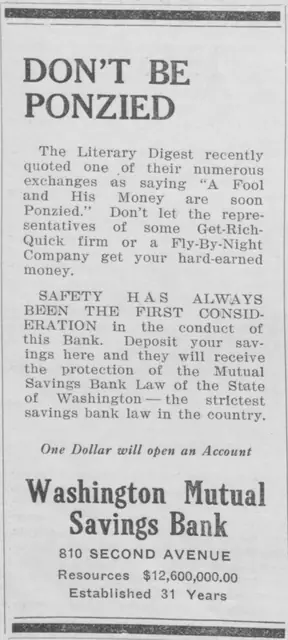
The English language absorbed his name. The legal system codified the structure. Every financial fraud prosecutor in the world now uses the phrase he made necessary. Every journalist covering the cases in this series reaches for it. Every investor who has ever been told that returns are generated by arbitrage or algorithm or technology has, somewhere in the back of their mind, the awareness that this has a name.
The name is his.
Myth distinguished from record throughout. Ponzi's autobiography is self-serving and used with care. Figures flagged for primary verification are labelled below. The Boston Post investigation is contemporaneous journalism verified by subsequent historians.
VERIFY BEFORE PUBLICATION McMasters exact payment (~$5,000) · Daily intake figure ($250,000/day at peak) · William W. Miller direct inspiration link · Pulitzer Prize attribution · Final assets at death (~$75)
IDENTITY
CASE RECORD
 ▶ WATCH
HE NAMED THE THING THE THING IS STILL RUNNING
Charles Ponzi did not invent the Ponzi scheme. The structure — paying earlier investors with later investors’ money, maintaining a cover story about legitimate returns, collapsing when inflows can no longer fund redemptions — predates him. William W. Miller ran the “Franklin Syndicate” in Brooklyn in 1899, promising 520% annual returns. [SOURCE: Wikipedia / secondary — verify to primary before publication]
What Ponzi contributed was the version that stuck. He ran it in one summer in one city with one promise, and the Boston Post documented it in a way that gave the English language a permanent name for the pattern. Every fraud prosecutor in the world now uses the phrase he made necessary.
The template. The record-holder. The man the scheme is named after. The scheme that is named after him.