Caroline Ellison
TAP TO READ FULL NARRATIVE — SHE TESTIFIED ANYWAY (2,700 WORDS)
She was the only person who could explain the why.
Not the what — the mechanics of how FTX customer funds moved to Alameda Research could eventually be reconstructed from the code, the financial records, the blockchain. Not the how — the documents and digital trail, even the ones Bankman-Fried had allegedly destroyed, could be recovered with forensic effort. The what and the how were things investigators could, in principle, piece together from evidence.
The why required her.
She had run his firm. She had been his girlfriend. She had sat in the rooms where the decisions were made and understood the reasoning — what he had believed, what he had decided not to believe, what he had said and done when the math started not adding up. She was, in the government's precise phrase, 'uniquely positioned to explain not only the what and how of Bankman-Fried's crimes, but also the why.' [SOURCE: DOJ sentencing letter, September 17, 2024]
She pleaded guilty in December 2022 — immediately, before the year was out. She began cooperating before she was charged. She testified in open court in October 2023 and named him. She told the court everything she knew.
While she was preparing to testify, he leaked her private diary to a reporter.
She testified anyway.
Caroline Ellison was born in November 1994 in Boston, Massachusetts.
Her parents are Glenn Ellison and Sara Fisher Ellison — both professors of economics at MIT. [SOURCE: CNBC / Reuters / case brief] The family is not background detail. It is essential context. She grew up in a household where quantitative economic reasoning was the medium of daily intellectual life. Where the way you evaluated a claim was to ask what the evidence showed and how the mechanism worked. Where rigour was a household value before it was a professional one.
She attended Stanford University for her undergraduate degree. From Stanford she went directly to Jane Street Capital — the elite quantitative trading firm that has a specific kind of reputation in financial circles: selective, sophisticated, producing people who are exceptionally good at a particular kind of numerical reasoning under uncertainty. It is where Sam Bankman-Fried had also worked. It is where the two of them met.
She was drawn to the effective altruism framework that Bankman-Fried and others in their circle subscribed to — the idea that the right way to do the most good in the world was to earn as much as possible and donate it as effectively as possible to causes that reduced the most suffering. As a fellow effective altruist, she was attracted to the prospect of earning money in order to give it to charity. [SOURCE: Yahoo News / Fortune]
He persuaded her to join Alameda Research, the quantitative cryptocurrency trading firm he had founded in 2017. She did. She rose through the organisation. She became co-CEO of Alameda in 2021. When her co-CEO Sam Trabucco stepped down in August 2022 — three months before the collapse — she became sole CEO.
She was 28 years old when FTX filed for bankruptcy. She was 28 when she pleaded guilty. She was 28 when she testified. She was 29 when she was sentenced. She is 31 now.
The relationship between Caroline Ellison and Sam Bankman-Fried was not beside the operation. It was inside it.
They had met at Jane Street. He recruited her to Alameda. She ran the firm he had founded. He founded and ran the exchange, FTX, that the firm he had founded was secretly borrowing from. They lived together in the Bahamas — in the $30 million penthouse at the Albany compound on New Providence island where Bankman-Fried and ten FTX colleagues lived and worked. [SOURCE: Fortune / biography.com]
The romantic relationship was on and off across years — from approximately 2018 until mid-2022, in the period before the collapse. [SOURCE: biography.com; Yahoo News] It was, throughout, concurrent with the professional relationship: she ran his firm, he ran the empire, and the two companies they each led were secretly entangled in a way that would eventually consume both of them.
The DOJ's sentencing letter describes her as Alameda's 'nominal CEO' — the government's own language establishing that while she held the CEO title, the decision-making authority ran to Bankman-Fried. [SOURCE: DOJ sentencing letter, September 17, 2024] That distinction is part of her legal record, part of her cooperation, and part of the context of the relationship. She ran the firm. He controlled it.
She was, before the collapse, unhappy. The New York Times published an article in July 2022 — based on her personal writings — in which she described feeling 'unhappy and overwhelmed' at work and 'hurt/rejected' by a breakup with Bankman-Fried. [SOURCE: Yahoo News citing NYT]
Those writings would become the instrument he used against her.
Alameda Research was the vehicle through which FTX customer deposits were misappropriated. She ran Alameda Research.
Customer funds deposited on FTX — the exchange — were used by Alameda to cover the trading firm's losses, service its obligations, and fund an operation that included expensive real estate in the Bahamas, speculative investment positions, and political donations. The two entities were not kept separate as they were supposed to be. [SOURCE: DOJ trial record; Second Circuit opinion, June 2026]
She directed the use of customer funds to cover Alameda's losses and obligations. She knew the real balance sheet — the one that showed the true state of things — while the public-facing disclosures said something different. That gap between private knowledge and public statement is the core of the fraud she participated in.
The government's sentencing letter is precise about this: she was 'forthcoming about her own grave misconduct and the role she played in furthering Bankman-Fried's scheme and its concealment.' [SOURCE: DOJ sentencing letter, September 17, 2024]
Grave misconduct. That is the government's language. She committed it. That is in the record and it belongs in this piece. So is the full context of what she did with that record when the operation ended.
When FTX collapsed in November 2022 and the federal investigation began, Caroline Ellison started talking to the government.
Not after her lawyer negotiated a deal. Not after she understood the full scope of what she was facing. Before she was charged. [SOURCE: DOJ sentencing letter, September 17, 2024 — stated directly in the filing]
She was charged in December 2022 with seven counts: wire fraud, securities fraud, money laundering conspiracy, and related charges. She pleaded guilty the same month. Immediately. She did not contest the charges. She did not seek to litigate the facts. She said she had done what the government said she had done and began helping them build the case.
Over the months that followed, she participated in what the government described as extensive document review — work that identified key corroborating evidence in an investigation that had been hamstrung by Bankman-Fried's systematic destruction of evidence. He had tried to eliminate the record. She helped reconstruct it. [SOURCE: DOJ sentencing letter, September 17, 2024]
Her statements during the cooperation were, the government noted, 'notably consistent' with what she had said during the collapse of FTX — before she had any reason to believe she was being investigated. She had not changed her story to fit a plea deal. Her account of what had happened was the same before and after the federal investigation began. [SOURCE: DOJ sentencing letter]
While Caroline Ellison was cooperating with federal investigators and preparing to testify against Samuel Bankman-Fried, he leaked her private personal writings to a reporter.
The New York Times published an article in July 2022 — before the collapse — based on her personal writings in which she described feeling unhappy and overwhelmed at work. [SOURCE: Yahoo News citing NYT, July 2022] Those writings were personal. They were not intended for publication.
After the collapse, after the charges, after she had pleaded guilty and was cooperating with the government, Bankman-Fried allegedly shared her personal writings with a reporter — this time to try to damage her credibility as a witness. A federal judge found that this action 'likely amounted to witness tampering' and revoked his bail. He was held in pretrial detention for the remainder of the pre-trial period. [SOURCE: Yahoo News / Fortune, citing federal court record]
The government's sentencing letter to Judge Kaplan addresses this directly.
This piece does not quote her private writings. It will not. The government's own filing documents that those writings were weaponised against her. Quoting them would repeat that act. What this piece reports is that he did it, that a federal judge found it was likely witness tampering, that it was documented in a government filing, and that she testified anyway.
She was publicly humiliated with her own words. By the man she had loved. By the man she had worked for. By the man she was about to testify against in open federal court. He did it while facing the same charges she did.
She went to court and named him anyway.
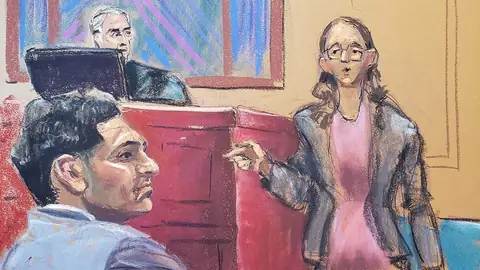
On October 10, 2023, Caroline Ellison took the stand in the trial of Samuel Bankman-Fried in the Southern District of New York.
She testified about the mechanics of what had happened — how Alameda had used FTX customer funds, how the balance sheets had been constructed, how the gap between the private reality and the public statements had been maintained. She provided the kind of granular, first-hand account of decisions and conversations and reasoning that only someone who was there and paying attention could provide.
She also testified about the relationship. About the conversations between her and Bankman-Fried. About what he had known, what he had directed, what he had said when things were going wrong. The government had called her 'uniquely positioned' to explain the why — and that uniqueness rested on the fact that she had been both his closest professional partner and his romantic partner. She knew the public man and the private one. She knew what he said in the rooms that mattered.
She testified for multiple days. She was cross-examined by his defense lawyers. She held to her account.
The jury convicted Samuel Bankman-Fried on all seven counts on November 2, 2023 — one year to the day after the CoinDesk balance sheet article that had started the collapse.
On September 24, 2024, Caroline Ellison stood before Judge Lewis A. Kaplan in the Southern District of New York.
She was tearful. The AP's headline: 'Tearful Caroline Ellison gets 2 years in prison over her role in FTX fraud.' [SOURCE: AP News, September 24, 2024]
Her parents had written to the judge ahead of sentencing — Glenn Ellison and Sara Fisher Ellison, both MIT economics professors, writing on behalf of their daughter. The New York Times published the letter. [SOURCE: NYT — verify contents before quoting directly]
She spoke to the court. She expressed remorse. The government's letter had already described her as showing 'remarkable candor, remorse, and seriousness' throughout the cooperation period.
The government's sentencing letter to Judge Kaplan, dated September 17, 2024, is the primary document on her cooperation. It runs through every element of what she did and why it mattered. The direct quotes are the record. They belong here in full.
This series has a thesis for each case. A single thing the case documents about how fraud works at scale, and about the people inside it.
Hushpuppi: the persona was the marketing. Malone Lam: the speed. Do Kwon: the product was the lie. Madoff: duration was the disguise. Bankman-Fried: the trust of the smart. Caroline Ellison: the one who knew, and told.
She is not the usual template for a case in this series. She is not primarily the fraudster, though she committed grave misconduct. She is not primarily the victim, though she was betrayed by the person she had worked for and loved. She is not primarily the hero, though the prosecution's most important witness is the closest the criminal justice system gets to one.
She is something more complicated: a person who made catastrophically wrong choices, who recognised them for what they were when she had the chance to do so, and who chose to tell the truth when telling the truth was both the legally optimal and the most costly personal choice available to her.
The legally optimal part: she understood that full cooperation was the fastest path to the shortest sentence. The most costly personal part: she was cooperating against the man she had loved, who was also weaponising her private writings to try to stop her. She did both things simultaneously. The cooperation track and the personal betrayal ran at the same time.
Her testimony is the reason the jury had what it needed to convict. Her document review is the reason the prosecution had evidence in a case where the defendant had systematically destroyed it. Her pre-investigation statements are the reason the government could establish that she had not changed her story to fit a deal.
She was the only person who could explain the why. And she did. In open court. On the record. Under cross-examination. While her former partner's lawyers tried to pick apart what she said.
She was sentenced to two years. She has been released. She is 31 years old. She has the rest of her life ahead of her, carrying the things she did and the things she chose when it ended.
Her private writings are not quoted in this piece. The DOJ filing documents that they were weaponised against her. Quoting them would repeat the act. What is reported: that it happened, that a judge found it was likely witness tampering, that it is in the government filing. She is a living person, released, who cooperated. Report per the court record only.
IDENTITY
CASE RECORD
WHAT THIS CASE ESTABLISHED
 ▶ WATCH


 ▶ WATCH
WHAT ELLISON DID — AND WHAT SHE SAID AT TRIAL
FROM THE BENCH
CONNECTED CASE
Case 005 and Case 006 are the same fraud, two different roles, two different choices. Bankman-Fried maintained his innocence, testified, and was convicted on all 7 counts. Ellison pleaded guilty immediately, cooperated fully, testified against him for three days, and served 14 months. The outcomes — 25 years vs 14 months — are the clearest illustration in this series of what cooperation means inside the federal sentencing system.