Bernie Ebbers
TAP TO READ FULL NARRATIVE — THE LEDGER (1,000 WORDS)
The fraud was a filing decision.
WorldCom paid other telecommunications carriers to use their networks — a cost called 'line costs.' Line costs are expenses. They reduce profit. If a company is under pressure to hit a quarterly earnings target, line costs are the number standing between the reported result and the target.
The accounting decision, as the DOJ and SEC later established, was to book those expenses as capital expenditure — turning operating costs into investments spread across future years. This transformed losses into reported profits. Nobody moved money to an offshore account. Nobody invented a product that did not exist. The fraud was entries in a spreadsheet — line costs, classified as capital expenditure, quarter after quarter.
The entries added up to approximately $11 billion in overstated earnings. When they were found — by an internal auditor named Cynthia Cooper who refused to stop asking questions — the company was already insolvent. [SOURCE: DOJ; SEC; widely reported from trial record]
On July 21, 2002, WorldCom filed for bankruptcy — then the largest in US history, with assets of approximately $107 billion. Approximately 30,000 people lost their jobs. Employees who held WorldCom stock in retirement accounts saw it fall to nothing. [SOURCE: DOJ; widely reported]
Bernard John Ebbers was born August 27, 1941, in Edmonton, Alberta, Canada. He co-founded LDDS — Long Distance Discount Service — in 1983. Through a series of acquisitions across the 1990s, most significantly the 1998 acquisition of MCI (then America's second-largest long-distance carrier), LDDS became WorldCom and WorldCom became a major force in telecommunications.
At its peak, WorldCom had a market capitalisation of approximately $180 billion. It was America's second-largest long-distance carrier, a major data and internet provider, and — to Wall Street — a model of the new communications economy. Ebbers was its face: a physically imposing, folksy CEO who drove pickup trucks and wore cowboy boots.
The pressure to sustain the stock price of a $180 billion company was the context in which the fraud began. Quarter after quarter, the company had to hit its numbers. When the numbers could not be hit legitimately, they were made to appear hit through accounting.
The fraud was operated primarily by Scott Sullivan, WorldCom's CFO, who pleaded guilty and cooperated with prosecutors. The prosecution's theory: Ebbers set the targets and created the culture of pressure; Sullivan made the accounting decisions to meet those targets. The entries reclassified 'line costs' — fees paid to other carriers for network access — as capital expenditure.
This is called capitalisation of operating expenses. Some expenses can legitimately be capitalised when they produce long-lived assets. Line costs do not qualify — they are purely operating costs that reduce the current period's profit. Reclassifying them as capital expenditure hid them from the profit-and-loss statement and put them on the balance sheet as assets instead.
The result: a company that was losing money appeared to be making money. Quarter after quarter, from approximately 1999 to 2002, for a total overstatement of approximately $11 billion. Analysts had targets. The targets appeared to be met. The stock held.
Cynthia Cooper, vice president of internal audit, discovered the fraud in 2002. She and her team worked nights and weekends, avoiding advance notice to senior management, tracing entries back to their source. When she brought the findings to the audit committee in June 2002, the company had no survivable path. The bankruptcy filing came July 21, 2002.
Ebbers' defence was that he was not an accountant. That he had trusted his CFO. That he had not known the specific entries were being made. The prosecution's theory was different: he had set the targets, maintained the pressure, and received fabricated results, knowing or recklessly disregarding that they could not be legitimate.
The jury found the prosecution's theory compelling. Ebbers was convicted on all counts in March 2005 — securities fraud, conspiracy, and seven counts of false regulatory filings. He was sentenced to 25 years in federal prison in July 2005.
The appellate courts upheld the conviction through multiple rounds of appeal.
In December 2019, after serving about 13 years, Ebbers was released on compassionate grounds: Judge Valerie Caproni ordered it on 18 December and he walked out on 21 December. He was 78, legally blind and in failing health. He died on February 2, 2020 — approximately six weeks after release.
Approximately 30,000 WorldCom employees lost their jobs when the company entered bankruptcy. Many held WorldCom stock in their 401(k) retirement accounts — accounts the company had encouraged them to concentrate in WorldCom equity. When the stock went to nothing, those accounts went with it. People who had worked for decades lost their retirement savings. [SOURCE: widely reported from congressional testimony and DOJ record]
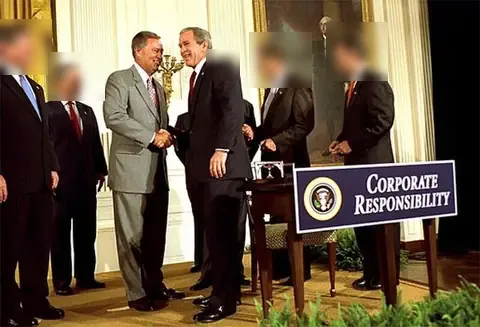
The legislative response was Sarbanes-Oxley — the Public Company Accounting Reform and Investor Protection Act, signed July 30, 2002. It required CEOs and CFOs to personally certify the accuracy of financial statements, imposed criminal penalties for false certifications, strengthened audit committee independence, and mandated enhanced internal controls. The corporate governance regime governing US public companies today was substantially shaped by WorldCom. [SOURCE: Sarbanes-Oxley Act, 2002]
The biggest accounting fraud in US history was a filing decision. Repeated.
IDENTITY
CASE RECORD
 ▶ WATCH
 ▶ WATCH
 ▶ WATCH
 ▶ WATCH
 ▶ WATCH