Trendon Shavers
TAP TO READ FULL NARRATIVE — PIRATEAT40 (600 WORDS)
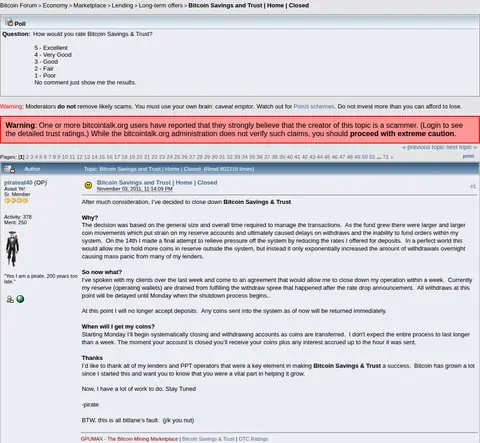
In 2011, when Bitcoin was worth less than a dollar, a user on BitcoinTalk named 'pirateat40' began advertising a managed Bitcoin investment program. Bitcoin Savings and Trust (BTCST) promised weekly returns of 7 percent — compounding — on Bitcoin deposits. The Bitcoin would be 'invested' on behalf of depositors. In reality, it was a Ponzi scheme.
Trendon T. Shavers, of McKinney, Texas, operated BTCST. He raised approximately 764,000 Bitcoin from investors between September 2011 and September 2012, per the SEC. At the prices of the time, this was worth approximately $4.5 million; the DOJ put the bitcoin he obtained fraudulently at about 146,000, worth about $807,380 at average prices over the scheme. The scheme paid early investors from later investors' deposits. When withdrawals outpaced new deposits, it collapsed.
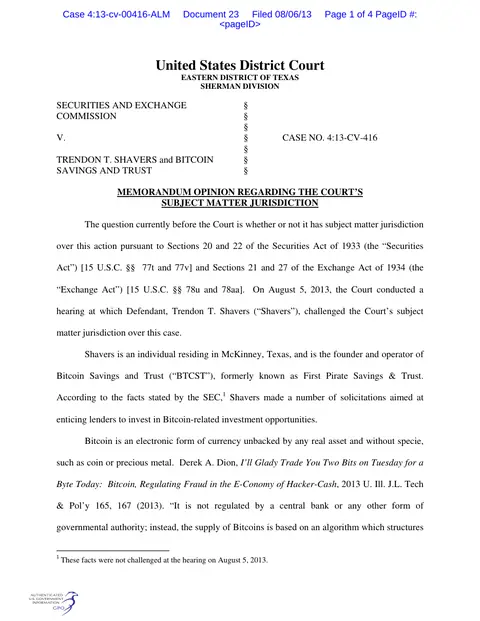
In 2013, the SEC charged Shavers with securities fraud. He responded with a defense that would become familiar: Bitcoin was not a currency or security, so the SEC had no jurisdiction. The argument went before US District Court Judge Amos Mazzant in the Eastern District of Texas.
Judge Mazzant ruled in August 2013 that Bitcoin is 'a currency or form of money' and that investments in Bitcoin can constitute investment contracts subject to federal securities law. This was the first time a US federal court made this ruling. [SOURCE: SEC v. Shavers, E.D. Texas, 2013] Every subsequent SEC enforcement action in the cryptocurrency space — including the most significant cases in this series — exists in the legal world Judge Mazzant's ruling created.
Shavers was charged criminally in Manhattan in November 2014 and pleaded guilty to securities fraud on September 21, 2015. On July 21, 2016 he was sentenced to 18 months in federal prison and three years' supervised release, and ordered to forfeit $1.23 million and pay the same in restitution — what his 48 investors lost. [SOURCE: DOJ/S.D.N.Y., July 21, 2016]
The 2013 Mazzant ruling is one of the most consequential single legal acts in the history of cryptocurrency regulation in the United States. Before it, there was a genuine question whether Bitcoin-based investment schemes fell within federal securities law. After it, that question was answered: they do, if they meet the other elements of an investment contract under the Howey test.
The series arc from Case 084 (BTCST, 2012) to Case 080 (BitConnect, 2018) to Case 005 (FTX, 2022) is a straight line: each successive case assumes the legal framework established by its predecessor. SBF did not need a 2024 ruling that FTX's activities fell under securities law; that ground was prepared in a Texas court eleven years earlier by a man who raised $4.5 million in early Bitcoin from a forum post.
The scale disparity is the series' most dramatic single number: 700,000 BTC raised in 2012 for approximately $4.5 million. The same number of Bitcoin would be worth tens of billions of dollars at 2024-2025 prices. The investors did not benefit from this appreciation — the coins were spent, moved, and lost in the scheme's collapse. But the figure illustrates how dramatically the asset class grew around the crimes being committed in it.
IDENTITY
CASE RECORD
 ▶ WATCH