Saw Chit Thu
TAP TO READ FULL NARRATIVE — THE ARMED LAYER (600 WORDS)
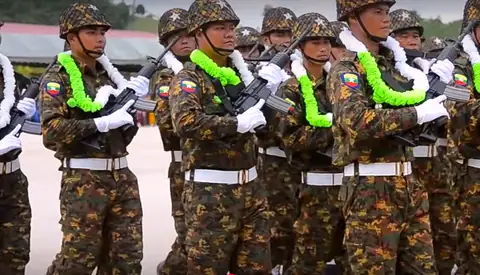
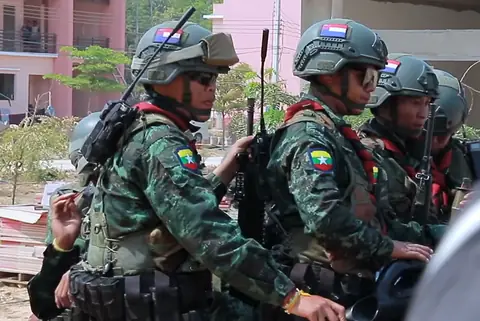
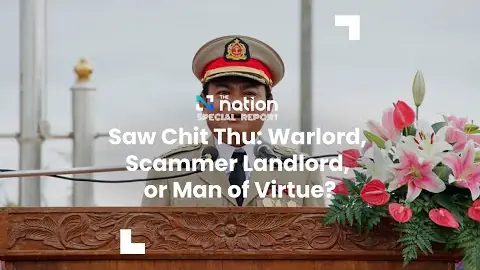
The compound ecosystem requires a complete stack: someone who builds the facilities (Case 054), someone who owns the operation (Case 052), someone who provides the financial infrastructure (Case 063), and someone who controls the territory and security. Saw Chit Thu — the leader of the Karen National Army (KNA), an armed group in Karen State, Myanmar — is, per OFAC, the last layer.
On May 5, 2025, the US Treasury Department's Office of Foreign Assets Control sanctioned Saw Chit Thu. The finding: Saw Chit Thu provided security and land to scam compounds operating in the area under the KNA's control. Britain had sanctioned him in December 2023 and the EU followed in 2024. [SOURCE: OFAC, 5 May 2025; UK FCDO, December 2023]
The Karen National Army is an armed group operating in Karen State, a region in eastern Myanmar that has experienced ongoing conflict between ethnic Karen armed organisations and Myanmar's central state for decades. The compound industry's presence in Karen State — documented by UNODC, Reuters, and others — reflects the same dynamic visible in Kokang: areas where armed groups control territory and where the central state's authority is limited are attractive to scam-compound operators because they can negotiate protection directly with the local power structure.
The OFAC designation does not come with a loss figure. That is not an oversight — it is an accurate characterisation of what the designation documents. Saw Chit Thu is sanctioned for a role, not for a specific monetary amount. He is a security provider, not the fraud operator. The fraud proceeds are in other cases in this set.
The enforcement instrument here is an OFAC sanction — the same administrative mechanism used against Evil Corp (Case 058, Yakubets), Huione Group (Case 063), and others in this series. The pattern: when arrest and prosecution are unavailable — because the subject is in an uncooperative jurisdiction, or because the evidence standard for criminal charges is not met — sanctions provide an alternative form of accountability.
An OFAC sanction means that any US person, bank, or entity that provides services to or does business with the designated individual or organisation risks violating US law and facing penalties. It does not constitute a criminal finding. It does not erase the designation's subject from the financial system as completely as a conviction might — but it creates practical barriers to operating in dollar-denominated markets.
For a militia commander in Myanmar, the practical reach of an OFAC sanction may be limited. Its value is primarily documentary — establishing the US government's formal finding that this actor provided support to scam-compound operations — and as part of a coordinated international pressure campaign that includes UK sanctions and UNODC reporting. The Myanmar civil war's ongoing dynamics make direct enforcement action against armed groups in Karen State unlikely through any conventional legal mechanism.
This case completes the compound-ecosystem picture in this series. Cases 052 through 065 now document: the owner (052), the city-builder (054), the recruiter (055), the territorial families (062/064), the financial infrastructure (063), and the armed security layer (065). The series' pig-butchering category is now the most comprehensively documented of any fraud method in the set.
IDENTITY
CASE RECORD
 ▶ WATCH


 ▶ WATCH
 ▶ WATCH
 ▶ WATCH
 ▶ WATCH
 ▶ WATCH
 ▶ WATCH