Emmanuel Nwude
TAP TO READ FULL NARRATIVE — THE AIRPORT (2,700 WORDS)
In 1995, Emmanuel Nwude told a Brazilian banker named Nelson Sakaguchi that he was Paul Ogwuma — the Governor of the Central Bank of Nigeria.
He was not Paul Ogwuma. He was a director at Union Bank of Nigeria, a different institution. But he had the confidence of a man in authority, the paperwork of a man in authority, and the detailed knowledge of Nigerian banking protocols that a man in authority would have. [SOURCE: DMARGE citing sources; NAN]
He told Sakaguchi that the Nigerian government was preparing to build a major new international airport in Abuja, the federal capital. The project was large. The contract was valuable. The commission on offer — $10 million — was extraordinary. And the man making the offer was, according to the documents in front of Sakaguchi, the Governor of the Central Bank of Nigeria.
Sakaguchi paid. Between 1995 and 1998, he paid $191 million in cash and the remainder in the form of outstanding interest — $242 million total — into accounts controlled by Nwude and his co-conspirators. [SOURCE: EFCC; NAN; Guardian Nigeria]
There was no airport. There was no contract. There was no Paul Ogwuma on the other side of the transaction. There was a letterhead and a man who had studied the architecture of authority well enough to reproduce its surface.
The fraud was discovered not by an investigator but by an accountant. In late 1997, Banco Santander attempted to acquire Banco Noroeste. In a joint board meeting, a Santander official asked why two-fifths of Noroeste's total value — half its liquid capital — was sitting dormant in the Cayman Islands. [SOURCE: NAN; Wikipedia citing sources]
That question ended the scheme.
He sold a banker an airport that did not exist. The letterhead said it was real, and for three years, for a quarter of a billion dollars, it was. Every advance-fee fraud since is a cheaper print of the same page — authority asserted, paperwork attached, a mark who wants to believe.
Nwude's career at Union Bank of Nigeria is the foundation the fraud was built on. He was not a random impersonator. He was a banking professional who understood exactly how correspondent banking relationships worked, how Nigerian state procurement processes were structured, and how a foreign banker would expect a major government contract to be presented.
The fraud required specific knowledge: how central bank letterheads were formatted, what language official Nigerian government contracts used, which payment routes were appropriate for a transaction of this scale, and how to maintain the impersonation of a specific individual — Paul Ogwuma, who served as CBN Governor from October 1993 to May 1999 — across a three-year transaction. [SOURCE: NAN — Ogwuma's tenure dates]
He had accomplices. Christian Ikechukwu Anajemba (killed in 1998), his wife Amaka Anajemba and Nzeribe Okoli all played roles in the operation. (Two lawyers, Emmanuel Ofulue and Obum Osakwe, were charged separately with trying to bribe the EFCC chairman — not with the fraud.) [SOURCE: Wikipedia citing multiple sources] The scale of a $242 million, multi-year deception required multiple people maintaining consistent stories across multiple jurisdictions.
Sakaguchi, for his part, appears to have been motivated by a genuinely extraordinary proposition — a $10 million commission on a transaction with the Nigerian government, mediated by the central bank governor. The commission alone was the kind of number that made due diligence feel like an insult to the relationship. The mark's psychology matters here not because Sakaguchi shares the blame — he does not — but because the fraud was engineered specifically to exploit the place where greed and institutional authority intersect. [SOURCE: brief; series principles]
The brief for this piece states the rule clearly: explain the mechanism, do not blame the victim. Sakaguchi was defrauded. The explanation for why a sophisticated banker paid $242 million to fraudsters is the same explanation for why Google and Facebook paid $122 million to a man with a fake invoice. The institution's verification process trusted the surface. The surface was carefully produced.
Sakaguchi paid in stages across three years. The total was $191 million in direct cash transfers and the remainder — approximately $51 million — in the form of accrued interest on the original principal between 1995 and 1998. [SOURCE: NAN; EFCC reporting]
The payments moved through accounts structured to receive them — a multi-layered operation that routed money through multiple jurisdictions. By the time the fraud was discovered in late 1997 through the Santander acquisition process, a substantial portion of the funds had been dispersed. The Cayman Islands account that triggered the discovery held the dormant remainder that Noroeste's balance sheet had obscured from routine review.
The collapse of Banco Noroeste was the human consequence. After the fraud was uncovered, the Simonsen and Cochrane families — the owners of Banco Noroeste — paid the $242 million liability themselves to facilitate the Santander acquisition. The bank was absorbed into Santander Brasil in 1999. [SOURCE: Wikipedia citing sources; NAN]
The fraud triggered criminal investigations in Brazil, Britain, Nigeria, Switzerland, and the United States. Sakaguchi himself was later arrested at New York's JFK airport and dispatched to Switzerland to face charges relating to the bank accounts he had used as part of the transaction — in effect, a victim who also faced legal consequences in multiple jurisdictions for his role in creating the banking infrastructure through which the fraud moved. [SOURCE: Wikipedia citing sources]
FIGURE
WHAT IT MEASURES
$242 million
Total extracted from Sakaguchi — $191M cash + ~$51M accrued interest. [SOURCE: EFCC / NAN]
$191 million
Cash portion paid by Sakaguchi, 1995–1998. [SOURCE: NAN / EFCC]
25 years
Sentence imposed by Justice Joseph Oyewole, Ikeja High Court, 2005. [SOURCE: NAN; Guardian Nigeria]
~3 years in custody
Arrested June 2003; sentenced November 2005 to five concurrent five-year terms; released 2006. VERIFY the release date against the primary record.
3rd largest
Widely repeated description — 'third-largest bank fraud in history' at the time, after Barings and the Iraqi Central Bank. No original source found; treat as a description, not a finding.
The fraud is called 419 after Section 419 of the Nigerian Criminal Code, which makes advance-fee fraud a criminal offence. The designation is a legal fact about where the law was codified. It is not a characterisation of a country.
The 419 template — in its foundational form — has three elements: an authority figure, an extraordinary opportunity, and documentation that reproduces the surface of legitimacy. Nwude's operation ran all three at maximum scale.
The authority figure: the Governor of the Central Bank of Nigeria. Not a mid-level official. Not a fictional title. The highest-ranking monetary authority in Africa's most populous country, whose name and office were known to any serious financial institution operating in the region.
The extraordinary opportunity: a major infrastructure contract with a $10 million commission. The scale was designed to ensure that Sakaguchi would manage the relationship personally — at a level where due diligence was delegated downward and institutional checks were bypassed by the principals involved.
The documentation: forged correspondence on what purported to be Central Bank of Nigeria letterhead, supported by a contract for a facility that had been announced at the right institutional level to be plausible. [SOURCE: NAN; EFCC reporting] The airport in Abuja was not a random invention — Abuja was then Nigeria's new federal capital, and infrastructure development there was a credible government priority.
What the fraud did not require: hacking, malware, technical sophistication, or any computer capability beyond word processing. The entire $242 million extraction was accomplished with paper, a credible impersonation, and a mark who had every incentive to believe the deal was real.
Hushpuppi (Case 001) sent a spoofed email. Rimasauskas (Case 017) sent a fake invoice. Nwude sent a forged letter on official letterhead. The technique is identical across three decades and two continents. Only the medium changed. The exploit — authority asserted, paperwork attached, verification trusting the surface — has not been updated since 1995.
Emmanuel Nwude was convicted by the Ikeja High Court in 2005. The presiding judge was Justice Joseph Oyewole. The sentence was 25 years imprisonment. [SOURCE: NAN; Guardian Nigeria; The Cable]
The conviction was the first major prosecution for the Economic and Financial Crimes Commission — the EFCC, established by the Nigerian Parliament in 2002 at the request of President Olusegun Obasanjo specifically in response to the scale of advance-fee fraud emanating from Nigeria. [SOURCE: NAN] Nwude's case was not merely a landmark for its size; it was the founding conviction of Nigeria's primary anti-financial-crime institution.
He was arrested by the EFCC on June 4, 2003, and arraigned in February 2004. He pleaded guilty on November 18, 2005, and was sentenced to five years on each of five counts, to run concurrently — 25 years on paper, five in effect. He was released in 2006: about three years in custody. [SOURCE: ThisDay, November 2005; Financial Times, October 2008 — verify the release date against the primary record]
The plea came with a settlement: $110 million to be refunded to the bank and $11.5 million paid to the Federal Government from his companies, which were to be wound up, along with fourteen properties, six cars and more than 100 million shares. By 2008 the bank's lawyers reported about $138 million recovered across Nigeria, Switzerland, the US and the UK. [SOURCE: ThisDay, November 2005; ICC Commercial Crime Services]
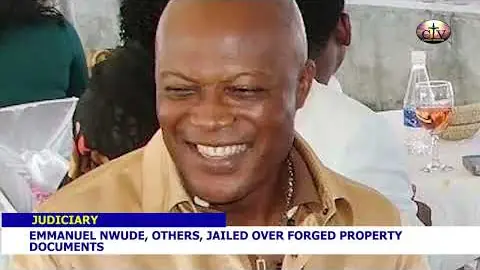
After release, Nwude subsequently faced a 15-count charge for allegedly forging documents related to a property that Justice Oyewole had ordered him to forfeit to his victims — in effect, charged with fraud in the aftermath of a fraud conviction, relating to assets that were supposed to go to restitution. [SOURCE: NAN; The Cable] On March 11, 2026, a Lagos court convicted him on 13 of those 15 counts and sentenced him to one year on each. [SOURCE: PM News; Channels TV, March 2026] He was also reportedly arrested in 2016 on murder charges related to an attack on a town in Nigeria. [SOURCE: Wikipedia — verify primary]
The sentence was 25 years on paper — five five-year terms running at the same time. The outcome was about three years in custody.
This gap is the honest final note the brief asks for, and it is the same accountability question that runs through Case 015 (CZ, $4.3B company penalty, 4 months served, then pardoned) and Case 017 (Rimasauskas, $122M BEC, 5 years sentenced, released after sentence). In the Nwude case the gap is more extreme: a quarter-century sentence became a fraction of that, with the money substantially unrecovered.
Banco Noroeste did not survive as an independent bank. The families who owned it paid the $242 million liability out of their own assets to facilitate the Santander sale. The bank was absorbed into Santander Brasil in 1999. The restitution — whatever was returned through the plea arrangement — did not repair that outcome.
The series does not editorialize on this gap. It records it. The sentence and the time served are two different numbers. The loss and the recovery are two different numbers. Recording both is the minimum the victims of any fraud are owed by any account of what happened.
He is a living private individual. This piece reports the court record and the public record of his conviction. It does not speculate about his current circumstances beyond what the documented record establishes.
Case 021 is where the BEC/advance-fee category begins. Not historically — the technique is older than Nigeria, older than banking — but in the documented series record that runs from Hushpuppi (001) through Rimasauskas (017) to this case, Nwude is the origin.
He is the proof that the exploit is not technical. It is psychological. Authority, once asserted convincingly, is treated as real by institutions built to verify authority. The check on authority is usually the letterhead, the title, the established relationship. When those can be reproduced, the check fails.
Every spam filter, every email authentication protocol (SPF, DKIM, DMARC), every vendor verification process that Google and Facebook implemented after the Rimasauskas fraud — all of it is a response to the same problem Nwude ran in 1995 with a typewriter and a telephone. The digital defenses grew around a human vulnerability. The vulnerability has not changed.
The Nigerian Criminal Code's Section 419 gave the fraud its name not because Nigeria invented it but because Nigeria was where it was codified into law as a specific offense — a recognition that the technique had become organised at industrial scale. The EFCC, which Nwude's conviction inaugurated as a serious institution, exists for the same reason. The prosecution record is documented; the generalisation is not this piece's business.
He sold a banker an airport that did not exist. The letterhead said it was real, and for three years, for a quarter of a billion dollars, it was. Every scam email since is a cheaper print of the same page — authority asserted, paperwork attached, and a mark who wants to believe. The airport was never for sale. It never had to be.
VERIFIED SOURCES AND CORRECTIONS RECORD
EXTENSIVE VERIFICATION REQUIRED — this case has significant folklore in circulation. Brief contained two factual errors corrected above. State both the 25-year sentence AND the time actually spent in custody (about three years). No national stereotyping — the 419 reference is a legal fact, not a characterisation.
[1] NAN (News Agency of Nigeria) — court coverage, 2021: 'I didn't know how $242m got into my account.' Confirmed: Ikeja High Court, Justice Joseph Oyewole, 2005 conviction. Sentence: 25 years. $191M cash + remainder interest = $242M total. Sakaguchi as director of Banco Noroeste. Nwude's impersonation of Paul Ogwuma (CBN Governor, October 1993–May 1999).
[2] Guardian Nigeria — '$242m airport scam: I'm unaware of source of funds, Nwude tells court.' Same facts. EFCC described as: Nwude 'convinced a director of the bank, Nelson Sakaguchi, to buy a yet-to-be-built airport in Abuja for $242 million.' Third-largest bank fraud in history at time.
[3] The Cable — '$242m airport scam: I don't know anything about the money, says Nwude.' Reports the 15-count post-conviction charge for forging forfeited property documents. First major EFCC conviction confirmed.
[4] DMARGE — detailed reconstructed account: Santander acquisition December 1997 trigger; Cayman Islands dormant funds; the $10M commission; co-conspirators named; the end of Banco Noroeste (absorbed by Santander, 1999).
[5] Wikipedia — Emmanuel Nwude. Confirmed: 'Date apprehended: February 2004; released in 2006.' Title: Director of Union Bank of Nigeria (not CBN). Also: Sakaguchi arrested at JFK and dispatched to Switzerland. Nwude arrested on murder charges 2016. [Aggregator — verify all to primary]
CORRECTIONS TO BRIEF (1) EMPLOYER: Union Bank of Nigeria, not CBN. He impersonated Paul Ogwuma, CBN Governor. (2) AIRPORT: fictitious new airport in Abuja, not Murtala Muhammed International Airport. (3) TIME SERVED: about three years in custody (arrested June 2003, released 2006); the 25 years ran as five concurrent five-year terms.
TO VERIFY BEFORE PUBLICATION Exact birth date · Union Bank of Nigeria employment dates and title · Precise US court involvement (if any — this appears primarily to be a Nigerian prosecution) · Exact plea arrangement terms and amounts returned · Primary EFCC sentencing documents · The 2016 murder charge outcome · Co-defendant outcomes (Christian Anajemba reportedly assassinated — verify) · $110M offered to return (brief figure — not found in available sources)
IDENTITY
CASE RECORD
 ▶ WATCH