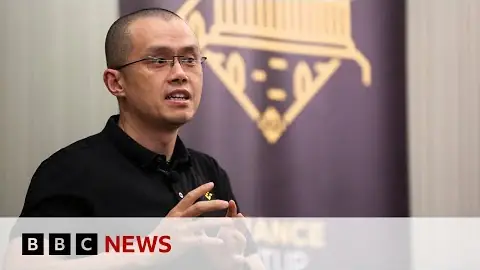
Changpeng Zhao (CZ)
TAP TO READ FULL NARRATIVE — THE DOOR (2,600 WORDS)
In November 2022, FTX collapsed. Sam Bankman-Fried had taken $8 billion in customer funds and used them to cover losses at his trading firm. He was convicted on all seven counts. He is serving 25 years in federal prison in California.
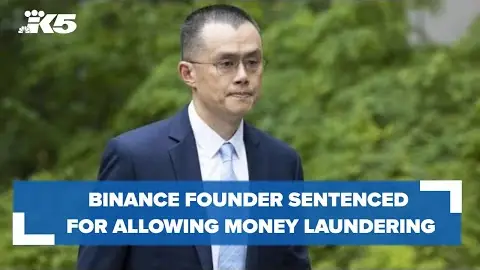
The man whose tweet — announcing Binance would sell its FTT holdings — triggered the bank run that ended FTX was Changpeng Zhao. CZ. The founder and CEO of Binance, the largest cryptocurrency exchange in the world by trading volume.
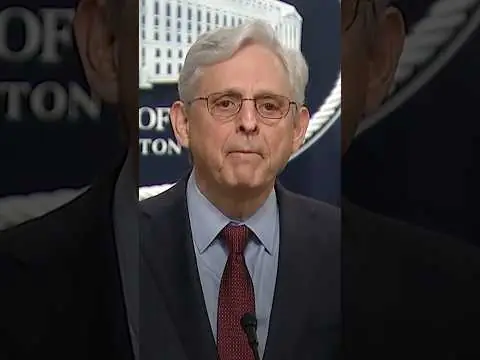
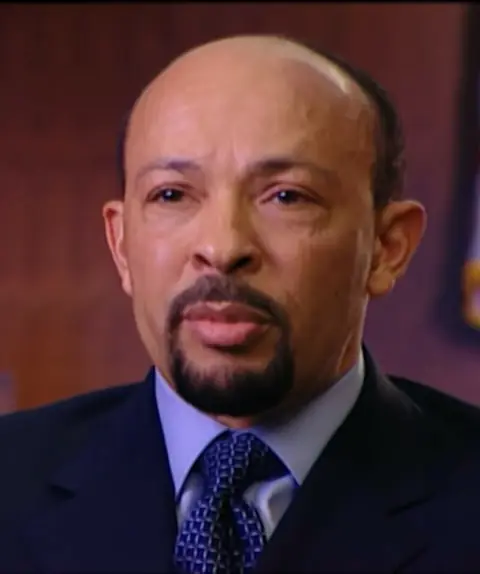
One year after FTX collapsed, on November 21, 2023, CZ pleaded guilty in federal court in Seattle. His charge: one count of failing to maintain an effective anti-money-laundering program, in violation of the Bank Secrecy Act. Binance simultaneously agreed to a resolution with the US Department of Justice totalling $4.3 billion — one of the largest corporate penalty settlements in American history.
He was sentenced to four months in federal prison. He served them. He was released in September 2024.
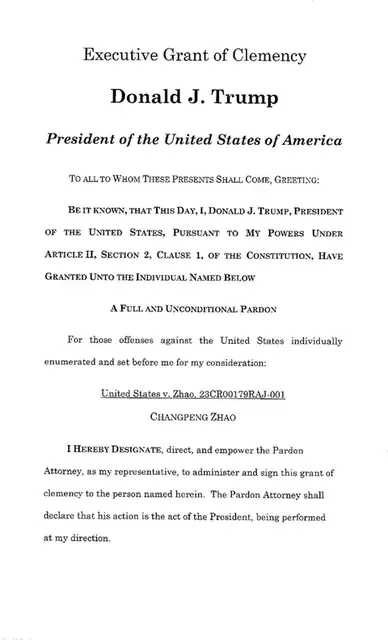
On October 23, 2025, President Donald Trump granted him a full and unconditional presidential pardon. [SOURCE: AP / Reuters / Axios / White House, October 23, 2025]
These two men — SBF and CZ — are the two dominant figures in the crypto exchange story of this era. Their cases are not the same case. The series treats them as separate because they are separate. SBF committed fraud. CZ failed at compliance. The distinction is not a technicality. It is the entire moral and legal difference between the two outcomes.
Changpeng Zhao was born on September 10, 1977, in Jiangsu province, China. He emigrated to Canada with his family in the late 1980s and grew up in Vancouver. He attended McGill University in Montreal, where he studied computer science.
His career before crypto was in finance and technology: he worked at the Tokyo Stock Exchange, at Bloomberg Tradebook on their futures-trading systems, and eventually at firms with cryptocurrency exposure including OKCoin. By 2017 he had enough understanding of both the technology and the trading mechanics to found his own exchange.
He founded Binance in 2017 with an initial coin offering, originally based in Hong Kong. The timing was exceptional: the 2017 crypto bull market was accelerating, retail interest in cryptocurrency was exploding globally, and there was genuine demand for an exchange that offered more tokens with lower fees than the existing platforms. Binance grew with extraordinary speed.
By the early 2020s, Binance was the largest cryptocurrency exchange in the world by trading volume. Not one of the largest — the largest. It processed more trades, in more currencies, with more users, than any other platform. CZ was one of the wealthiest people in the world, with a net worth estimated in the tens of billions at peak, though most of that wealth was tied to the value of BNB, Binance's own token. He was, by any reasonable measure, one of the most powerful individuals in cryptocurrency.
The Bank Secrecy Act requires US financial institutions to know who their customers are, to monitor their transactions, and to file reports of suspicious activity. This is the foundational anti-money-laundering framework for American finance — the infrastructure that makes the financial system harder to use for drug trafficking, terrorism financing, sanctions evasion, and other illicit purposes.
Binance violated it. That is the plea. That is the conviction — or rather, the conviction before the pardon. What the DOJ found:
First: Binance failed to register as a money services business as required under US law, even while serving US customers. The company claimed, including through geolocation restrictions and IP blocking measures, that it did not serve US customers. The DOJ found this claim was not implemented effectively — US customers continued to transact on the platform. [SOURCE: DOJ press release, November 2023]
Second: Binance failed to implement an adequate Know Your Customer programme. For years, users could open accounts and trade without providing meaningful identifying information. The 'know your customer' requirement exists specifically to prevent the exchange from becoming a conduit for illicit finance. Binance's implementation of this requirement was, per the DOJ, inadequate.
Third: As a consequence of these failures, Binance processed transactions connected to entities and activities that US sanctions law prohibited. The DOJ stated that Binance processed transactions for users with connections to Hamas, al-Qaeda, ISIS, and darknet markets. [SOURCE: DOJ plea agreement; AP coverage of sentencing] These are not allegations in the uncertain sense — they are part of a guilty plea. They happened.
The scale of these failures — across the world's largest exchange, over years of operation, while the company actively sought to avoid US regulatory oversight — is what made this the largest corporate settlement the DOJ had reached with a cryptocurrency business at the time. [SOURCE: DOJ November 2023]
He was not charged with fraud. He was not charged with misappropriation. He was not charged with stealing customer deposits. He was not accused of taking money that belonged to his customers and using it for anything.
This distinction matters because the public narrative around CZ — particularly in the period after FTX's collapse, when he was the most prominent remaining figure in major crypto exchanges — sometimes carried the implication that he was the same kind of actor as Bankman-Fried. He was not.
Binance's customers, as of this writing, can access and withdraw their funds. The exchange did not collapse. There was no bankruptcy. There was no $8 billion hole in the balance sheet. The compliance failures were real and serious — the transactions that moved through Binance included proceeds of crimes that harmed real people — but the mechanism of the harm was different from the mechanism in the FTX case.
The FTX harm: customers deposited money expecting it to be held safely, and it was taken. The customers were the direct victims.
The Binance harm: criminals used the exchange to move proceeds of their crimes because the exchange did not implement adequate controls to stop them. The exchange's customers were not the victims. The victims of the underlying crimes were the victims — and the exchange's failure made it easier for those crimes to continue profiting.
Both harms are real. They are not the same harm. The legal system recognised this, and the sentence reflects it: 25 years for SBF, 4 months for CZ. The White House, when announcing the pardon, stated that CZ's prosecution involved 'no allegations of fraud or identifiable victims.' [SOURCE: White House / Axios, October 23, 2025] That framing is contested by the DOJ's own filing, which identifies specific categories of crime enabled. But the structural difference between the two cases is accurately stated.
The penalty structure is where this case is most unusual in the series. The gap between the company's payment and the individual's fine is the story.
Binance agreed to pay $4.3 billion to resolve the DOJ, Treasury/FinCEN, and CFTC actions. This is one of the largest corporate penalty resolutions in the history of financial enforcement. It included fines and forfeiture across multiple agencies. [SOURCE: DOJ November 2023; Bloomberg analysis]
CZ's personal fine: $50 million. [SOURCE: DOJ plea agreement]
The ratio: the company paid 86 times what CZ paid personally. This structure — massive corporate penalty, relatively modest personal fine, short prison term — reflects the DOJ's assessment of the case as a compliance failure by a business that had grown faster than its regulatory infrastructure, rather than a personal fraud committed by an individual who set out to steal.
The $4.3 billion is a company number. It belongs to Binance. It represents the value the DOJ assessed for years of inadequate controls at the world's largest crypto exchange. It must not be attributed to CZ as a personal liability or a personal theft figure. He personally paid $50 million. These are different numbers measuring different things.
He also stepped down as CEO of Binance as part of the plea. Richard Teng has run the exchange since. CZ retained his equity stake.
When Judge Richard A. Jones sentenced Changpeng Zhao to four months in federal prison in April 2024, he was sentencing the first person in American history to receive a prison term for a single violation of the Bank Secrecy Act.
This is not a minor historical footnote. The Bank Secrecy Act has been in existence since 1970. It is the foundational anti-money-laundering law of the United States. Violations of it have resulted in corporate fines, regulatory actions, and civil penalties across the entire history of the modern financial system. Nobody had ever gone to prison for a single count of BSA violation before CZ.
The DOJ sought 36 months. CZ's lawyers sought no prison time. Judge Jones imposed 4 months — below the DOJ's request, above zero, and historically unprecedented for the specific charge. [SOURCE: AP / Reuters sentencing coverage, April 2024]
The unprecedented nature of the prison sentence is itself a data point about the scale of the failure. The DOJ had determined that the world's largest crypto exchange had operated in violation of anti-money-laundering law for years, at a scale and with consequences — the Hamas, al-Qaeda, ISIS, darknet market transactions — that justified a penalty that had never been applied to this charge before.
He reported to FCI Lompoc in California in June 2024. He was released in September 2024 after serving approximately four months. The prison was minimum security.
On October 23, 2025, President Donald Trump granted Changpeng Zhao a full and unconditional presidential pardon.
CZ had applied for the pardon in 2025, after serving his sentence. He acknowledged the application publicly, noting that he was 'the only one in US history who was ever sentenced to prison for a single BSA charge.' [SOURCE: Fortune, May 2025; CZ via X]
White House Press Secretary Karoline Leavitt announced the pardon and characterised Zhao's prosecution as part of the Biden administration's 'war on cryptocurrency.' She stated there had been 'no allegations of fraud or identifiable victims' in the case. [SOURCE: Axios / AP, October 23, 2025]
The pardon erases his conviction and restores his civil rights. He posted on social media: 'Deeply grateful for today's pardon and to President Trump for upholding America's commitment to fairness, innovation, and justice.' [SOURCE: CZ via X, October 23, 2025]
What the pardon does not erase: the $4.3 billion Binance penalty. The company's settlement stands. The DOJ's findings about what Binance allowed to happen — the sanctioned-entity transactions, the BSA violations, the inadequate AML programme — are part of the historical record. The pardon removes CZ's personal criminal conviction. It does not change what the exchange did.
The pardon also fits a broader pattern. In his second term, Trump pardoned multiple crypto industry figures including Ross Ulbricht (whose life sentence for the Silk Road dark web marketplace was terminated), and three founders and an executive of BitMEX — who had also pleaded guilty to BSA violations. [SOURCE: Fortune, May 2025] CZ's pardon was the highest-profile of these, given Binance's scale.
The thesis for Case 015 is the door.
He built Binance — the world's largest cryptocurrency exchange — without building the controls that the law requires to prevent that exchange from being used for money laundering, sanctions evasion, and the financing of organisations designated as terrorist by the United States government. The controls were inadequate. The door, in the relevant sense, was not guarded.
The series argument: every other case in this collection is about people who took money, or built a fake product, or ran a scheme. CZ's case is about what happens when you build something real and powerful and don't build the compliance infrastructure around it.
Binance processed genuine transactions for genuine users. It was a real exchange running real trades in real currencies for real people who wanted to trade cryptocurrency. The compliance failures were failures of an institution that was growing faster than its regulatory framework — not a fraud designed to steal from customers.
That is not an excuse. The transactions that moved through Binance because the controls were inadequate — the Hamas-connected transactions, the ISIS-connected transactions, the darknet market transactions — had real-world consequences. The people whose crimes were made easier by a non-compliant exchange were doing things that harmed people. The exchange's compliance failure was a material contribution to that harm, even though CZ was not the person doing the harm.
He built the door. He did not guard it. The company paid $4.3 billion. He served 4 months. Then a president pardoned him, framing the prosecution as the prior administration's 'war on cryptocurrency' and characterizing the BSA violation — a compliance failure without direct victims in the FTX sense — as regulatory overreach.
The ratio is the story: $4.3 billion from the company, $50 million from the individual, 4 months in a minimum-security prison, then a full pardon. That is the structure of accountability for the world's largest crypto exchange running an inadequate anti-money-laundering programme for years. Whether that ratio reflects proportionate justice is a question this series leaves for the reader — but the numbers are the record and they speak plainly.
$4.3B = Binance company penalty. $50M = CZ personal fine. Never combine. NOT charged with fraud, theft, or misappropriation. Conviction erased by pardon October 23, 2025 — $4.3B company penalty not affected. He was the first person ever sentenced to prison for a single BSA violation.
VERIFY BEFORE PUBLICATION Exact BOP entry and release dates · $1.8B forfeiture vs fine breakdown within the $4.3B · Exact sanctioned entity names in the DOJ plea agreement · Exact Binance user count cited in DOJ filings
IDENTITY
CASE RECORD
WHAT THIS CASE ESTABLISHED

 ▶ WATCH
 ▶ WATCH
 ▶ WATCH
 ▶ WATCH
NOT THE SAME CASE
Judge Richard A. Jones · Seattle · April 30, 2024 [SOURCE: CNBC / AP]
FULL AND UNCONDITIONAL — PRESIDENT TRUMP
CZ via X · October 23, 2025 [SOURCE: Axios / AP]
The pardon erases his conviction and restores his civil rights. It does NOT affect the $4.3B Binance company penalty — the corporate settlement stands. The DOJ’s findings about what Binance allowed to happen are part of the historical record. The pardon removes the personal criminal conviction. It does not change what the exchange did. White House: “no allegations of fraud or identifiable victims” — a framing contested by the DOJ’s own filings. [SOURCE: AP / Reuters / Axios, Oct 23 2025]
Part of a broader pattern: Trump also pardoned Ross Ulbricht (Case 013) and three BitMEX founders who had also pleaded guilty to BSA violations. [SOURCE: Fortune, May 2025]