Charlie Green
INDIVIDUALBORN IN 🇺🇸 UNITED STATES ▸TAP TO READ FULL NARRATIVE — THE INSIDE HAND (600 WORDS)
Every check-fraud scheme needs checks. The question is where they come from. Charlie Banks Green Jr., a United States Postal Service worker, supplied a fraud ring with checks stolen directly from the mail — Treasury checks among them — and California unemployment debit cards, over four years.
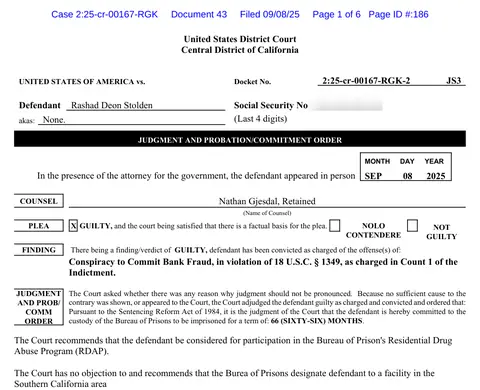
From 2020 through August 2024, Green — a letter carrier at the Bicentennial Post Office in the Fairfax district of Los Angeles — removed mail containing high-value checks during the course of his postal work, together with his friend and fellow carrier Rashad Deon Stolden, and sold the checks to co-conspirators who cashed them with counterfeit identity documents. The face value of the stolen checks exceeded $10 million. He pleaded guilty in April 2025 to one count of conspiracy to commit bank fraud, and on September 15, 2025, Judge R. Gary Klausner sentenced him to 66 months in federal prison and ordered $1.62 million in restitution. [SOURCE: US Attorney's Office, C.D. Cal., September 15, 2025; USPS OIG, September 2, 2025]
He pleaded guilty; Stolden pleaded guilty to the same count and received the same sentence two weeks before him. The case is documented in the Central District of California. The ring members — the people who received the checks and converted them — have their own cases and their own records. Green's role in the supply chain was access: a position of trust, used daily, for four years, to remove instruments of payment at their source.
The postal worker as the fraud supply chain's weakest link is not a new story — the US Postal Inspection Service has documented increasing rates of mail theft and check-fraud supply-side cases across the 2019-2023 period. The systemic pattern predates and accompanies Green's specific case; his entry in the series stands for the structural point, not just the individual conduct.
The check-fraud sub-category in this series runs across three cases. Case 089 (E.F. Hutton) is the system-level case — a firm exploiting the banking settlement process from inside the financial system. Case 090 (Green) is the supply-side case — an insider removing the physical instruments that enable fraud. Case 091 (Alexander) is the demand-side case — the man who received and converted stolen instruments in a separate ring in Cincinnati.
Together these three entries document a fraud category that predates digital crime and has persisted alongside it. Mail theft and check fraud increased sharply in the United States between 2020 and 2024, driven partly by pandemic-era postal system disruptions and partly by the organised crime infrastructure that developed to exploit them. Green's case, 2020 to 2024, sits squarely in that period.
The accountability question in supply-chain crime is who the system can reach. The converter in Cincinnati (Case 091, Alexander) and the supplier in Los Angeles (Case 090, Green) both faced prosecution in the United States — because both were present and identifiable. Cases where the supply chain crosses borders are far harder to close.
IDENTITY
CASE RECORD